Shipman resident honored for years of work protecting the environment
Shipman resident and environmentalist Susan McSwain recently was awarded an Earth Flag from the Sierra Club, in recognition of her work for years to beautify her Nelson
County community. The club, an environmental organization with chapters in all U.S. states, Washington, D.C. and Puerto Rico, awards the Earth Flag to individuals or groups who have made significant contributions to protecting and preserving the natural environment.
McSwain, originally from Florida, moved to Nelson County from Northern Virginia in 2000. She said she and her husband fell in love with Nelson’s rural lifestyle after spending a year looking at properties. “One of the appeals of Nelson County is we knew we could move here and not be considered outsiders for the rest of our lives,” McSwain said. “I know what’s it like to live in a place where you’re not considered a native.” Three miles from a paved road, she has felt accepted and at home as a Nelsonian for the past quarter-century.

The gravel road in front of her 1850 American Chestnut tobacco barn was the impetus for her longest-running volunteer project in her participation in the annual nationwide butterfly count sponsored by the North American Butterfly Association (NABA). Every year, butterflies congregate in the road by the tobacco barn to drink from rain puddles and take in minerals and salts from the earth, she said. Some 50 species of butterflies have been observed in this area, and in 2004, she joined the NABA count in Nelson County and convinced the man who ran it to include her road as an approved count location, she said. In 2011, she assumed responsibility for running the Nelson count, which she has organized for the past 15 years, she said. In addition to the official count, she also leads butterfly walks at other times of the year in various locations in Nelson County for people who want to learn more about butterflies.
McSwain and her friend Paulette Albright, of Montebello, in 2003 worked to address horrendous litter and dumping that occurred at the county’s solid waste sites at the time,
she said. Nearly 20 years ago, the county operated 21 unsupervised sites where anyone could drop off items at open-top containers littered with broken glass, cannisters of used oil, old mattresses, broken TVs and even dead animals, she recalled. “They were like the armpit of Nelson County,” McSwain said of the open-container sites. “They were really bad. There was no recycling.” She recalled a few years after moving to the county seeing a couple lower their 10-year-old boy into the dump sites to collect aluminum to sell. She was appalled by the conditions and wanted to improve it. McSwain and Albright embarked on a months-long project to visit each dump site, taking photos and making extensive notes, while also visiting staffed collection centers in other counties and interviewing a wide range of people in the solid waste industry, McSwain said. They drew up a plan and met with Nelson County Board of Supervisors members individually to get input and it received the board’s unanimous approval, she said. The county currently has one of the finest solid waste collection center systems in the state with four gated, staffed sites that offer recycling, McSwain said. “I wouldn’t call it an easy fix, it was something I could personally do as a citizen,” McSwain said. “I had always been interested in waste. I just thought the county could do better and do it more affordably.”
McSwain also rolled up her sleeves with Albright to start Keep Nelson Beautiful, a former organization that conducted road projects, including the “March on 56,” a massive cleanup on Virginia 56. Three years in a row, she said successive Saturdays in March were dedicated to cleaning sections of the highway. “It was always in the month of March, and we did the whole 56 corridor,” McSwain said. Keep Nelson Beautiful operated from about 2003 to 2013, and its primary goal was to clean up litter and educate people about recycling, she said. Land conservation also long has been of interest to McSwain. She served two years as president of the Thomas Jefferson Water Resources Protection Foundation before volunteering for the Central Virginia Land Conservancy, which holds easements in the counties of Nelson, Amherst, Appomattox, Buckingham and Campbell. McSwain also serves on the board of trustees for the Blue Ridge Land Conservancy that holds easements in counties surrounding Roanoke. She said the Central Virginia Land Conservancy takes easements on smaller properties, opening up them up to people with less than 100 acres. “It filled a gap,” McSwain said. “Last year we took in 1,000 acres from various people.” Her Shipman property of 475 acres is under a conservation easement. “For us, it’s kind of a legacy,” McSwain said. “When you put property under an easement, it means it can only be divided up according to what the terms of the easement are. It was important to us to protect the land to harbor the plants and animals that are here.” Protecting wildlife corridors is dear to her, she said. “There is a major corridor from Buckingham to the Blue Ridge Mountains and our property is smack in the middle of it,” McSwain said.
She became a founding member of the Central Blue Ridge chapter of the Virginia Master Naturalist program in 2007 and nine years later, she was selected as Volunteer of the Year by the VMN program for her work on numerous projects over the years. One of her favorite activities is leading nature walks, and she often recruits volunteers with
special areas of expertise to help teach participants about the animal and plant life encountered on the walks that she organizes. “I think it’s one of the best organizations that a person who is interested in the environment can join,” McSwain said. “It opens up all sorts of doors that you wouldn’t know existed if you weren’t a Master Naturalist. It provides a lot of educational opportunities.”
McSwain also maintains a tower built to provide a roosting and nesting site for chimney swifts, a species of birds, and years ago found they were roosting in an old chimney at
Nelson County’s courthouse in Lovingston. During the courthouse renovations in recent years she said she informed the county about the birds and an original plan to seal off the chimney was averted. She has organized “Swift Nights Out” where she invites people to observe and learn about the birds as they enter the chimney at dusk. She credits former Supervisor Allen Hale with legwork on the county’s end to preserve the courthouse chimney.
Hale, who served as the Nelson board’s East District representative from 2006 to 2017, in an interview praised McSwain for her community work in volunteering for road and solid waste cleanups. “She… played a strong supporting role as a private citizen seeing that eventually have the kind of system we have here in the county, which I was happy to work on as a board member,” Hale said of the solid waste collection centers. “She was very effective with that.” Hale said she supported his local business in Arrington specializing in ornithology, the scientific study of birds, and has been a great contributor to the county’s beauty. “She absolutely did more than her part,” Hale said of her community participation. “She was always active.”
McSwain also served with the Wintergreen Nature Foundation for about six years, assisted with an Earth Day event at Wintergreen Resort and also served on the Nelson Ag/Forestal Districts Advisory Committee since its creation 20 years ago. She has organized meetings for landowners to learn about invasive plants and insects, uses of local timber and general land protection.
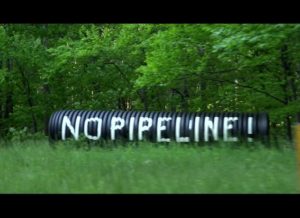
She also was active in opposing the Atlantic Coast Pipeline, a former natural gas project that announced its cancellation in the summer of 2020, and joined a 10-person team that delivered a presentation to the chair of the Federal Energy Regulatory Commission in Washington, D.C. “The very first route they proposed went through my property and it’s under
conservation easement. That got my attention immediately,” McSwain said. “It was going through the national forest; it was going through some very sensitive areas. They could have taken an existing route.” She felt the incentives were wrong for creating the pipeline and in her opinion, it was proposed solely for financial gain and not because the route was needed.
McSwain currently serves as secretary for Friends of Nelson, a group that fiercely opposed the pipeline, and she does research for information on a variety of topics such as data
centers, energy production and recycling. McSwain said she was surprised and extremely pleased to receive the Earth Flag during a May 1 recognition event at her Shipman home.
“I wanted to meet in the exact spot in the road where I became interested in butterflies,” she said. “We had a huge area in this gravel road where species of butterflies would mud puddle, we would see puddles of 300. It got me really interested. They were right there in that road.” She recalled being a child in Miami and her family visiting Bok Tower Gardens at the top of the Lake Wales Ridge, which she describes as like the continental divide in central Florida. “The gardens sit at the highest point on the ridge at 295 feet above sea level with a breathtaking 360-degree view of the countryside below,” McSwain said. She was 10 at the time and never forgot a sign with one of Edward Bok’s quotes she saw on a trail in the gardens: “Wherever your lives may be cast, make the world a bit better or more beautiful because you have lived in it.” She recalled taking a picture of that sign and it leaving a lasting impression on her.
Her parting message about supporting the environment: never see it as someone else’s responsibility.
“It is each individual person’s responsibility,” McSwain said. “You should never say that’s not my forest, tree, animal. We’re all in this together.”
article for the Nelson County Times by Justin Faulconer
jfaulconer@newsadvance.com